
Responsible Gaming
This is the most important page on the site. Real-money gaming is entertainment with a price attached, not a way to earn, and the mathematics guarantee that the price is paid over time. Here is how the economics actually work, how to recognise when play has stopped being recreational, and the practical tools that help.
Every game on platforms of this type is built with a house edge: the paytables are configured so the platform retains a percentage of everything staked. The platform does not need to cheat to profit, because the arithmetic already favours it. Individual wins happen and are real, but across enough rounds the expected result for a player is a loss. Any strategy, prediction system or “trick” sold as beating this is false.
Rules that actually protect you
- 01Decide the amount before you start, and treat it as the cost of the entertainment rather than a stake you expect back. When it is gone, stop for the day.
- 02Never borrow to play. Not from a person, not from a lending app, not from committee or savings money set aside for something else.
- 03Never chase a loss. Trying to win back what you have lost is the single most expensive behaviour in gambling, and fast round formats make it unusually easy.
- 04Set a time limit too, not only a money limit. Short rounds accumulate far faster than people estimate.
- 05Withdraw winnings rather than accumulating a balance on the platform.
- 06Never play to solve a money problem. It reliably makes the problem worse.
- 07Do not play while upset, tired or drinking. Every one of those degrades exactly the judgement you need.
- 08Keep it social and visible. Secrecy about how much you play is itself a warning sign.
What the app itself tells you
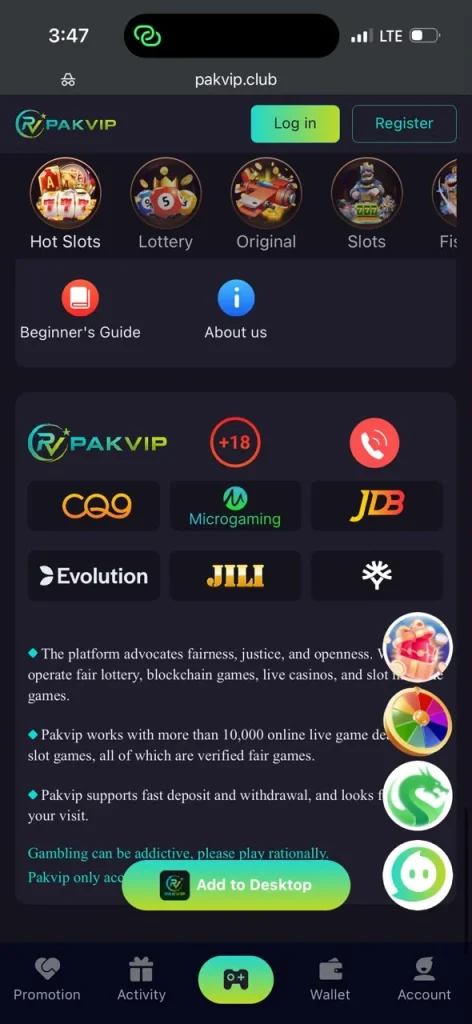
Worth noting, because it is easy to scroll past: the platform carries its own responsible-play notice and an 18+ mark on the home screen, stating that gambling can be addictive and asking users to play rationally. That notice is accurate, and it is the most honest sentence in the whole product.
Warning signs
These indicate play has moved from recreation to a problem. Any one of them is worth acting on; several together mean acting now.
- MoneySpending more than planned, or repeatedly returning to deposit again after telling yourself you had stopped.
- ChasingPlaying to recover losses rather than for enjoyment.
- BorrowingUsing borrowed money, credit, or funds meant for bills, rent, food or family.
- HidingConcealing how much you play or lose from people close to you.
- TimePlay displacing work, study, sleep or relationships.
- MoodAnxiety, irritability or low mood tied to results, or an inability to stop thinking about the next session.
- Failed stopsTrying to quit or cut down and not managing it.
Stop depositing now, tell someone you trust, and use the blocking tools below rather than relying on willpower alone. Gambling harm is a recognised condition and it responds to practical measures — removing access reliably works better than resolving to be more disciplined.
Practical tools that work
Use in-app deposit limits
If the platform offers deposit limits, session timers or break reminders in the account area, set them before you play rather than after a bad session. A limit set in advance is far more effective than one set in the middle.
Request self-exclusion
Ask support to close or suspend the account. Put the request in writing and keep the record. If a platform makes closing an account difficult, that tells you something important about it.
Block payments at the source
This is the most reliable step, because it does not depend on the platform's cooperation. Ask your bank or mobile wallet provider about restricting gambling-related transactions, and remove saved payment details from your phone.
Remove the app and the shortcuts
Uninstall the app, delete home-screen shortcuts and browser bookmarks, and leave any promotional Telegram or WhatsApp groups. Those groups exist to bring you back.
Install a blocking tool
Content-blocking software on your phone can restrict access to gambling sites, which raises the friction at exactly the moment when friction helps most.
Tell someone
A family member or friend who knows makes relapse harder and support easier. Isolation is what allows the problem to grow.
Getting help
If gambling is affecting your finances, work, studies or relationships, please talk to someone. A doctor or a qualified mental-health professional can advise on treatment, and problem gambling is treated seriously by clinicians. Speaking to family about the financial position, however difficult, is usually the step that changes things.
We are not a support service and we are not qualified to counsel anyone, so we are not going to list helpline numbers we cannot verify are currently operating in Pakistan — an out-of-date number at the moment someone needs it is worse than none. Please seek qualified local help, and use the payment-blocking and self-exclusion steps above immediately, since those work regardless of who you speak to.
Age restriction
These platforms are strictly for adults aged 18 and over. Do not let anyone under 18 use your account or your device to access them, keep your phone locked, and do not save login details on shared devices.
Legal context in Pakistan
Real-money gambling is restricted in Pakistan under the Prevention of Gambling Act 1977 together with provincial legislation, and the Pakistan Telecommunication Authority blocks platforms of this kind. This is a factual statement of the position rather than legal advice, and one practical consequence follows from it directly: because these platforms operate without a licence from a regulator with jurisdiction over you, there is no authority to escalate a dispute to if something goes wrong. Factor that into how much money you are willing to place at risk. We discuss it further on the real or fake page.